Navigating Compliance in International Money Transfers: A Complete Guide

Sarah Mitchell
25 March 2026
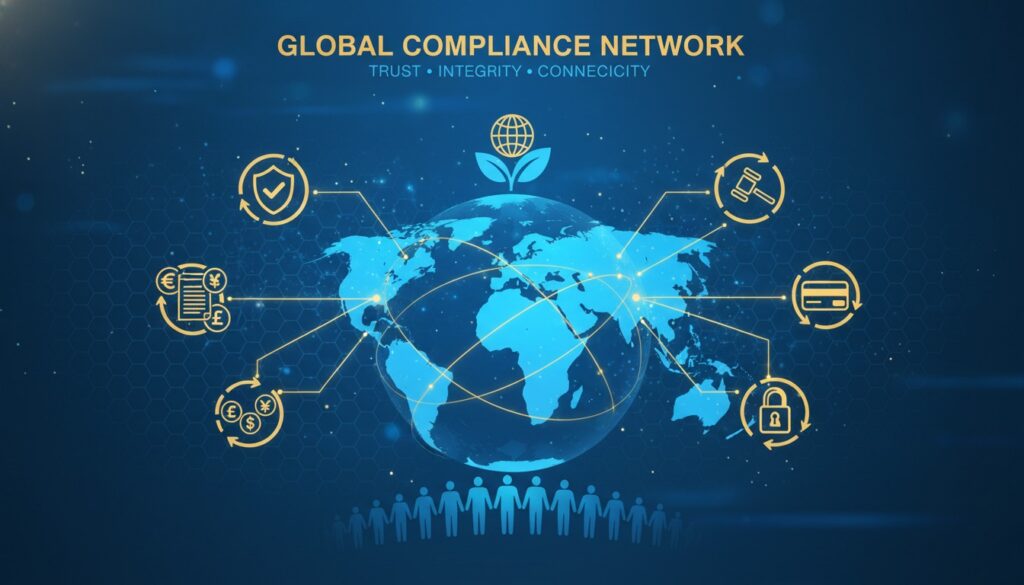
Navigating Compliance in International Money Transfers: A Complete Guide
Introduction
In today’s interconnected global economy, international money transfers have become the backbone of cross-border commerce. However, with great financial power comes great regulatory responsibility. The complex web of compliance requirements governing international payments can make or break your business operations.
Whether you’re a multinational corporation processing millions in daily transactions or a growing startup expanding into new markets, understanding the regulatory landscape is not optional—it’s essential. Non-compliance can result in hefty fines, operational shutdowns, and irreparable damage to your reputation.
This comprehensive guide will navigate you through the intricate world of international payment compliance, providing you with the knowledge and tools needed to operate confidently across borders while staying on the right side of the law.
Understanding the Global Regulatory Framework
The Foundation of International Payment Compliance
International money transfer regulations exist primarily to combat money laundering, terrorist financing, and other financial crimes. The regulatory framework is built on several key pillars:
- Anti-Money Laundering (AML) Requirements
- Know Your Customer (KYC) Protocols
- Counter-Terrorist Financing (CTF) Measures
- Economic Sanctions Compliance
- Data Protection and Privacy Laws
- Financial Crimes Enforcement Network (FinCEN)
- Office of Foreign Assets Control (OFAC)
- Federal Reserve System
- European Banking Authority (EBA)
- National competent authorities in each member state
- Financial Conduct Authority (FCA)
- HM Revenue and Customs (HMRC)
- Various national regulators with increasing coordination
- Customer risk profiles
- Geographic risk factors
- Product and service risks
- Transaction patterns and anomalies
- Flag unusual transaction patterns
- Monitor velocity and volume thresholds
- Screen against sanctions lists in real-time
- Generate alerts for manual review
- Full legal names and any aliases
- Date and place of birth (for individuals)
- Residential or business addresses
- Government-issued identification numbers
- Business registration documents (for entities)
- Politically Exposed Persons (PEPs)
- High-risk geographic locations
- Cash-intensive businesses
- Complex corporate structures
- OFAC Specially Designated Nationals (SDN) List
- UN Security Council Consolidated List
- EU Consolidated List
- National sanctions programs
- Continuously monitor customer databases
- Update screening lists regularly
- Investigate and resolve potential matches
- Maintain detailed records of screening decisions
- Currency Transaction Reports (CTRs) for transactions over $10,000
- Suspicious Activity Reports (SARs) for potentially illicit activities
- Recordkeeping requirements for international transfers
- U.S. persons worldwide
- Foreign entities using U.S. dollar clearing
- Transactions touching the U.S. financial system
- Lower thresholds for customer due diligence
- Enhanced beneficial ownership disclosure
- Expanded scope of covered entities
- Financial Intelligence Units (FIUs)
- Central beneficial ownership registers
- Enhanced cooperation mechanisms
- Risk-based approaches to AML/CTF
- Enhanced customer due diligence
- Improved international cooperation
- Cryptocurrency regulations
- Mobile money oversight
- Cross-border digital wallet compliance
- Senior management commitment and oversight
- Clear roles and responsibilities
- Regular board-level reporting
- Independent compliance function
- Customer onboarding procedures
- Transaction monitoring protocols
- Sanctions screening processes
- Record retention requirements
- Staff training programs
- Real-time sanctions screening
- Advanced name-matching algorithms
- False positive reduction techniques
- Audit trail maintenance
- Pattern recognition for suspicious activities
- Predictive risk modeling
- Automated case management
- Natural language processing for document review
- Regulatory requirements and updates
- Red flag identification
- Escalation procedures
- Cultural sensitivity in compliance
- Regularly updated to reflect regulatory changes
- Tailored to specific roles and responsibilities
- Supplemented with real-world case studies
- Measured for effectiveness and comprehension
- Focusing resources on high-risk areas
- Implementing graduated due diligence levels
- Leveraging automation for routine tasks
- Sharing compliance infrastructure across business lines
- Sanctions list management
- Customer screening services
- Regulatory reporting
- Compliance monitoring and testing
- Digital identity verification
- Pre-populated application forms
- Real-time decision making
- Clear communication of requirements
- Compliance requirements and timelines
- Documentation needs
- Processing delays and reasons
- Appeals and resolution processes
- Develop a risk-based compliance framework tailored to your business model
- Invest in technology solutions that scale with your operations
- Maintain ongoing training and awareness programs
- Stay informed about regulatory developments across all relevant jurisdictions
- Build strong relationships with regulators and industry peers
Key Regulatory Bodies and Their Jurisdictions
Different regions have established their own regulatory authorities to oversee international payments:
United States:
European Union:
United Kingdom:
Asia-Pacific:
“Compliance is not a destination, but a continuous journey that requires constant vigilance and adaptation to evolving regulations.”
Core Compliance Requirements Across Major Jurisdictions
Anti-Money Laundering (AML) Obligations
Risk Assessment and Management
Every organization handling international transfers must conduct comprehensive risk assessments that evaluate:
Transaction Monitoring Systems
Automated monitoring systems are essential for detecting suspicious activities. These systems should:
Know Your Customer (KYC) Requirements
Customer Identification Program (CIP)
Robust customer identification involves collecting and verifying:
Certain customer categories require additional scrutiny:
Sanctions Screening and Compliance
Real-Time Screening Protocols
All international transfers must be screened against multiple sanctions lists:
Screening is not a one-time activity. Organizations must:
Jurisdiction-Specific Compliance Considerations
United States: Navigating the Complex Regulatory Landscape
Bank Secrecy Act (BSA) Compliance
The BSA forms the foundation of U.S. AML requirements, mandating:
U.S. sanctions have extraterritorial reach, affecting:
European Union: The Fifth Anti-Money Laundering Directive
Enhanced Transparency Requirements
The EU’s 5AMLD introduced stricter requirements including:
EU member states must facilitate information sharing through:
Asia-Pacific: Emerging Regulatory Frameworks
FATF Recommendations Implementation
Asia-Pacific countries are increasingly aligning with Financial Action Task Force (FATF) standards:
The region’s rapid adoption of digital payments brings unique challenges:
Best Practices for Compliance Management
Building a Robust Compliance Program
Governance and Oversight
Effective compliance programs require:
Comprehensive policies should address:
Technology Solutions for Compliance
Automated Screening Systems
Modern compliance technology offers:
Emerging technologies enhance compliance through:
Staff Training and Awareness
Comprehensive Training Programs
All staff involved in international transfers need training on:
Compliance training must be:
Managing Compliance Costs and Operational Efficiency
Cost-Effective Compliance Strategies
Risk-Based Resource Allocation
Optimize compliance costs by:
Consider outsourcing for:
Balancing Compliance and Customer Experience
Streamlined Onboarding Processes
Improve customer experience while maintaining compliance through:
Keep customers informed about:
Conclusion
Navigating compliance in international money transfers requires a comprehensive understanding of the regulatory landscape, robust internal controls, and a commitment to continuous improvement. The complexity of managing multiple jurisdictions, evolving regulations, and technological advances demands a strategic approach that balances compliance obligations with operational efficiency.
Key takeaways for success:
Call-to-Action
Ready to strengthen your international payment compliance program? Start by conducting a comprehensive risk assessment of your current processes and identifying areas for improvement. Consider partnering with compliance experts who can provide tailored guidance for your specific business needs and help you navigate the complex regulatory landscape with confidence.
Don’t let compliance challenges hold back your global expansion. Take action today to build a robust compliance framework that supports your international growth objectives while protecting your business from regulatory risks.